
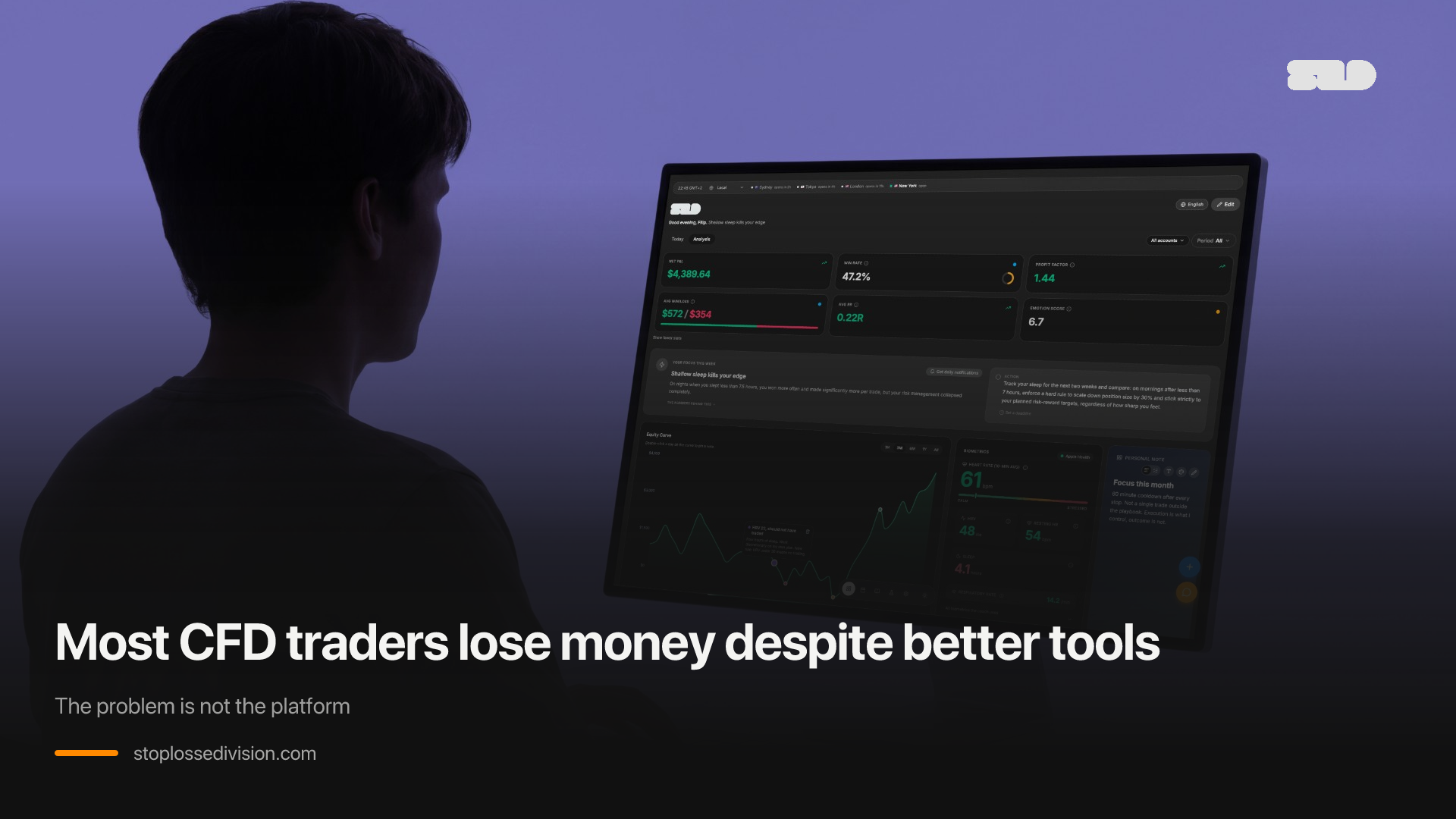
In 2018, ESMA, the European financial regulator, analysed retail CFD accounts across multiple member states and found that between 74 and 89 percent of them lost money. The average loss ranged from €1,600 to €29,000 per customer, depending on the country.
That was eight years ago, and the number hasn't improved. The platforms have gotten faster, the charts sharper, the spreads tighter. Every journal now calculates your win rate to two decimal places, and half of them have added AI features in the last twelve months. The tools are better than they've ever been, which means the problem isn't the tools.
The problem is who you were when you used them, or more precisely, what mental state governed your decisions at the time. Your edge doesn't disappear overnight, but your ability to execute it does when you're emotionally compromised or operating on autopilot.
Your journal shows what you did, not who you were
Most trading journals track outcomes, which makes sense until you realise that the outcome is the part you can't control. What you can control is the decision you made three seconds before you clicked, and that decision wasn't made by your strategy. It was made by a version of you with a heart rate fifteen beats higher than your baseline, sitting on two losing trades, telling yourself this one is different.
That state is measurable, and it predicts your result better than your win rate does. A 2005 study by Lo, Repin and Steenbarger found that traders who reported stronger emotional reactions to both wins and losses performed significantly worse. It wasn't the emotion itself, it was the amplitude. The ones who stayed flat, maintaining an even keel through volatility, stayed profitable over the long run.
And it starts before you notice it, often while you still feel completely in control. Research on a London trading floor in 2002 showed that even the most experienced traders had measurable changes in heart rate and skin conductance during market events, often without realising it. By the time you feel the tilt, your body has been broadcasting it for three minutes.
The gap between knowing and doing
Everyone knows revenge trading is a bad idea, at least in theory when they're calm and reflective. Everyone also does it, logs it afterwards as "impulse trade", and promises to do better next time. The issue isn't awareness, it's that you're judging the trade with the same brain that wanted it. That's testimony after the fact, which is why your journal says "slightly early entry on a valid setup" instead of what actually happened.
SLD measures the thing you can't lie about, which is your heart rate at the moment you took the trade. We pull it from your Apple Watch, log it next to your entry, and after enough trades we show you the pattern you've been looking at from the wrong angle. Not whether you won, but what state you were in when you decided.
We're testing this with ten traders
We built this because the expensive journals weren't measuring the thing that mattered, and because we got tired of paying €50 a month for a pivot table with a dark mode. Now we're opening a small pilot, inviting a limited group of traders, to see if it works for anyone other than the person who built it.
You'll need to log at least three trades a week, already keep a journal of some kind, and be willing to talk to us twice during the six-week period. In return, you get the tool for free during the pilot, and a 50% lifetime discount if you stay on afterwards.
If you'd rather build it yourself with Claude, we'll tell you how. Seriously, if you can prompt and you have time, do that instead. But if you want the biometrics wired in and you'd rather trade than code, this is the shortcut.
Help us test a journal that tracks your state, not just your stats, so you can see the patterns before they cost you. Sign up at stoplossdivision.com, where we're accepting early testers who are willing to give honest feedback.