
Someone on Reddit wrote this last month, and it's been stuck in my head ever since: "Why I took the trade and did it match my plan or was it impulsive are judgments made afterwards by the same brain that wanted the trade. That is testimony, not evidence."
That one sentence explains why ninety percent of trading journals don't work, even when you actually fill them in. You tick a box that says "disciplined" or "slightly early entry on a valid setup," and you move on. Three months later, you wonder why you're still breaking the same rules.
The reason is simple, and it's not that you're lying on purpose. It's that the brain that wanted the trade is the same brain that writes the review, and it will smooth over the uncomfortable parts without you noticing. That's not a character flaw, that's how memory works under pressure.
Your journal asks you to explain yourself after the fact
Most journals give you a dropdown menu for emotions, a slider for confidence, and a text box where you type why you took the trade. That makes the journal feel productive, but it doesn't make it useful.
What actually happened is this: your heart rate climbed three minutes before you clicked, your breathing got shallow, and you moved your stop before the candle even closed. None of that made it into the notes, because by the time you sat down to journal, you'd already decided it was a valid setup.
The Edgewonks and TradeZellas of the world let you track psychology, but only the psychology you're willing to admit to yourself. That's the problem, not the solution.
Evidence doesn't care what you think happened
In 2002, Lo and Repin measured ten professional traders during live sessions, using skin conductance and cardiovascular data. Even the most experienced traders showed significant physiological reactions during market events, and less experienced traders reacted on even more points.
What matters here is that the body responds before the story does, and it doesn't smooth anything over. Your heart rate doesn't lie about whether you were calm or not, it just records what it measured in that moment. It shows what was actually happening, without the edits your memory applies later.
In 2016, Kandasamy and his team went further. They found that traders who could sense their own heartbeat more accurately were more profitable, and stayed in the market longer. That's not about having a low heart rate, it's about being connected to the signal your body is already sending.
The problem with most journals is that they ask you to reconstruct that signal from memory, after your brain has already filed the trade under "reasonable decision" or "unfortunate timing." By then, the evidence is gone.
SLD logs both, so you can't smooth it over later
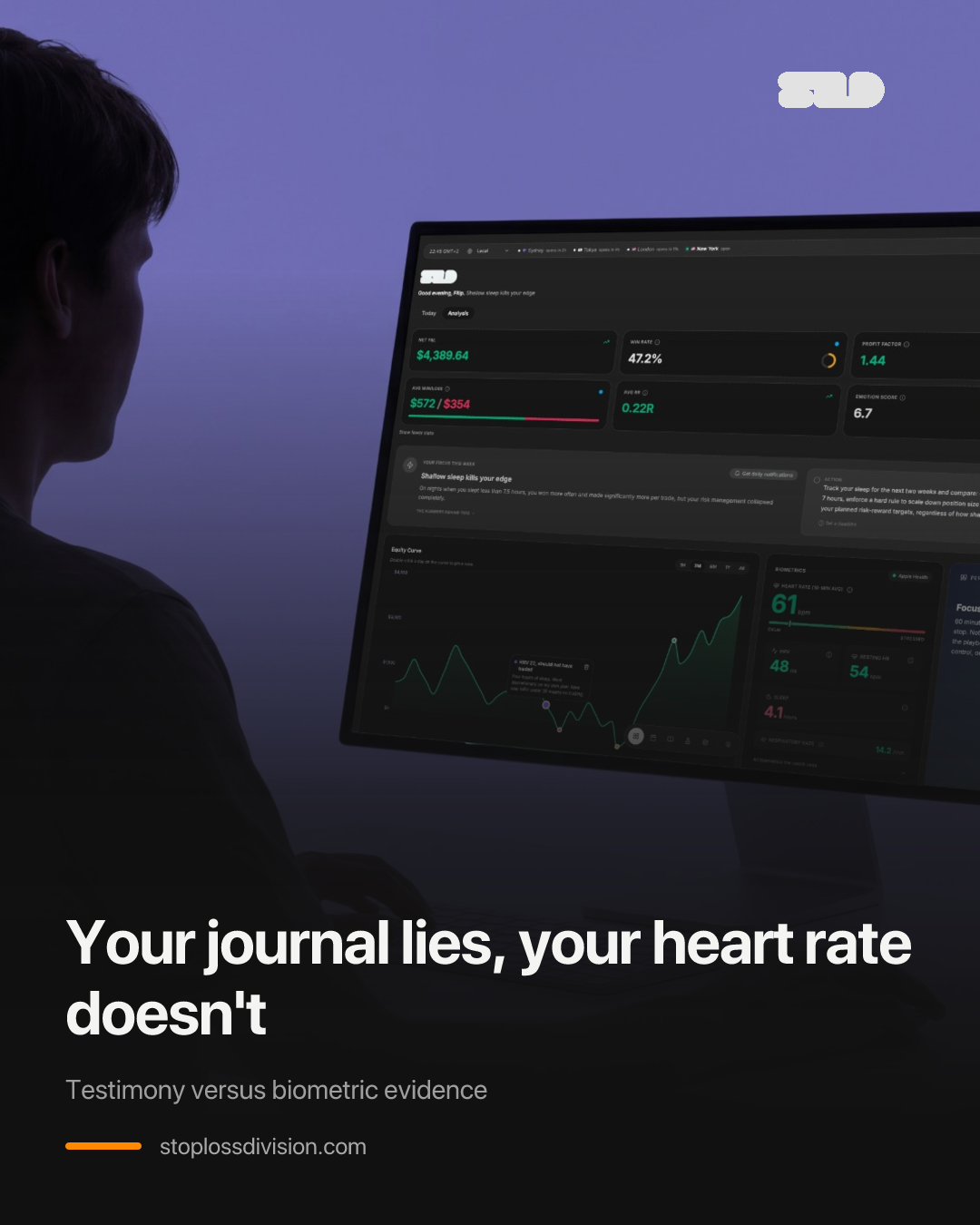
Your journal shows what you did, but it doesn't show who you were. SLD connects your trades to your biometric data from your Apple Watch or WHOOP, so that three months from now you can see that your worst trades didn't happen because the setup was bad. They happened because your heart rate was already at ninety-eight before you even opened the position, which tells you something your chart analysis never could.
That's not an accusation, it's a data point. And it's one you can actually act on, because it's not filtered through the part of your brain that wants to believe you had it under control.
We're not telling you what to trade, and we're not promising you'll make more money. We're showing you the gap between what you think you did and what your body was doing at the time, which is where the real story lives. That gap is where most traders lose, and it's the one thing the expensive journals don't measure.
We're opening a pilot for traders who want to test this
We're looking for ten traders to join a six-week pilot, where you log your trades and we connect them to your biometric data in real time. You'll need to be trading at least three times a week, already keeping some kind of journal, and willing to give feedback in two short interviews.
If that sounds like you, and you want to build a journal that tracks evidence instead of testimony, you can sign up at stoplossdivision.com. Pilot participants get lifetime access at fifty percent off once we go live, which means you lock in the rate before the official launch.
No dashboards full of win-rate stats, no gamified streaks. Just your trades, your heart rate, and the truth you couldn't see while you were in it.